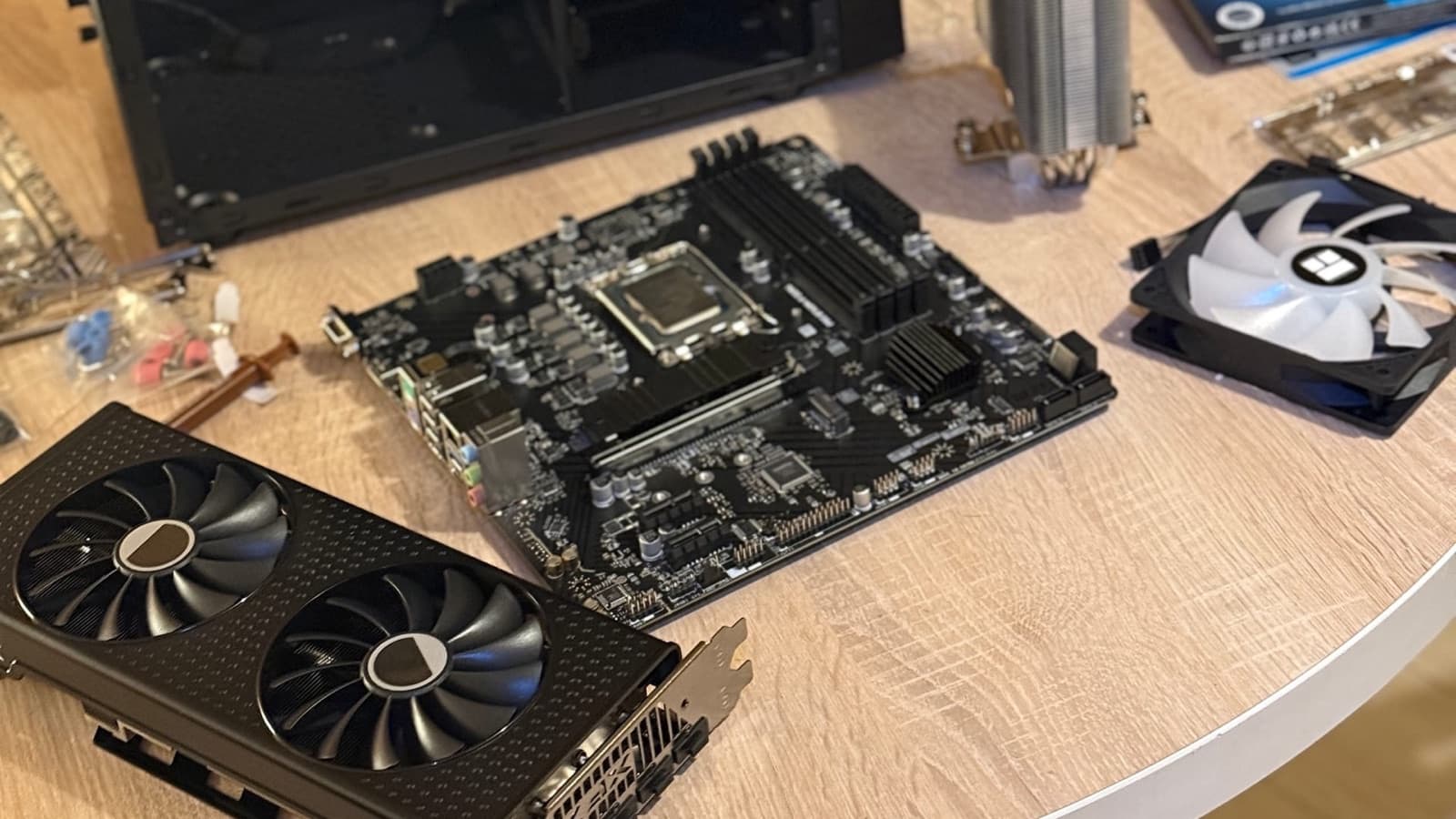
When someone hands me a gaming PC project, I always start from three things: the budget, the screen, and the games they want to play. Everything else follows. This guide uses the same reasoning, with real, dated prices, because in 2026 a buying guide without a date isn't worth much.
Prices recorded on 28 September 2026 from French configurators and price trackers (sources at the end of the article), so these are French retail prices, VAT included. The market moves every week: demand from artificial intelligence servers has caused a global memory shortage (TrendForce). Two reference points: in mid-August 2026, TopAchat estimated that a 32 GB DDR5 kit cost 3 to 4 times its early-2025 price, and Hardware & Co saw the 1 TB Crucial P310 SSD go from €75.99 to €149.99 between November 2025 and February 2026. Always check prices again when you buy.
Start from the screen, not the graphics card
The graphics card produces most of the frames per second, so it takes the biggest share of the budget. But it's the screen that decides which card you need: there's no point paying for a card built for 4K if you play on a Full HD 60 Hz monitor.
| Screen | Card to aim for | Price on 28 September 2026 |
|---|---|---|
| 1080p (Full HD) | RTX 5060 or RX 9060 XT 8 GB | from €459 (RTX 5060, median €499) |
| 1440p (QHD) | RX 9060 XT 16 GB or RTX 5060 Ti 16 GB | from €551 (RX 9060 XT 16 GB) |
| High-settings 1440p, reasonable 4K | RX 9070 XT or RTX 5070 Ti | from €812 (RX 9070 XT, median €903) |
| Comfortable 4K | RTX 5080 or above | from €1,490 (median €1,688) |
The graphics card prices above come from LaBonneConfig: the lowest price and the median across all tracked models, checked on 28 September 2026. On its performance index, the RX 9070 XT (20,815 points) beats the RTX 5070 Ti (19,091 points), which started at €1,071 the same day, and stays within about 13% of the RTX 5080: enough to aim for 4K at high settings at around 60 frames per second in many games, depending on the game and settings (the heaviest titles, especially with ray tracing, need lower settings or upscaling). The RTX 5070 (13,110 points, 12 GB of video memory) does worse, and its median that day (€931) was higher than the RX 9070 XT's (€903). NVIDIA keeps the edge in heavy ray tracing. Finally, a high refresh rate monitor (144 Hz and above) needs more power than a 60 Hz one at the same resolution.
Three typical budgets, September 2026 prices
The three builds below are based only on prices recorded in September 2026. They exclude the monitor, keyboard, mouse and Windows licence.
Entry level: gaming at 1080p
An AM4 platform with DDR4: end of life, but the processor and motherboard cost less (€223 to €234 here, against €261 to €320 for the Ryzen 5 7600X and B650 pair in the next build). DDR4 isn't spared by the shortage, though: in July 2025, TrendForce already reported 8 GB DDR4 modules priced above their DDR5 equivalents. Compare both when you buy.
Enough to play most recent games at 1080p on high settings. The 8 GB of video memory is this build's limit: in some recent games, you'll need to lower texture quality.
Mid range: gaming at 1440p
We move to AM5 and DDR5, a platform that leaves room to upgrade, and to a graphics card with 16 GB of video memory.
Note the RAM line: 32 GB of DDR5 currently costs more than three quarters of the price of the graphics card. That's the direct effect of the shortage.
High end: demanding 1440p and reasonable 4K
For more comfortable 4K, an RTX 5080 (from €1,490, median €1,688 on 28 September) brings this build's total to roughly €2,740 to €3,090; the 850 W power supply matches the minimum NVIDIA requires for this card.
What doesn't go out of date
Prices change; these rules much less so:
- Video memory. 8 GB is the minimum at 1080p. At 1440p, aim for 16 GB: the 12 GB of an RTX 5070 gets tight with maximum textures in recent games.
- RAM. 16 GB is enough for gaming at 1080p. 32 GB becomes useful at 1440p with recent games, especially if a browser, Discord or streaming software stays open.
- The processor. In games, a recent 6-core chip is enough to feed a mid-range card. Ryzen X3D chips, with extra cache, are the fastest in games, but also the most expensive.
- The power supply. Choose the wattage recommended by the graphics card maker (550 W for an RTX 5060, 650 W for an RTX 5070, 750 W for an RX 9070 XT), from a reputable brand with 80 PLUS certification. It's the part whose failure can take the others down with it.
- The platform. AM5 (Ryzen 7000 and 9000) leaves room to upgrade. AM4 and LGA 1700 are end of life; they accept DDR4 (on LGA 1700, depending on the motherboard), which can still help a tight budget or let you reuse existing memory modules.
- Storage. A 1 TB NVMe SSD at minimum: several big games exceed 100 GB each.
Build it yourself, have it built, or buy ready-made?
| Option | Pros | Cons |
|---|---|---|
| Build it yourself | Cheapest, you choose every part | Allow 2 to 4 hours for a first build, and troubleshooting is up to you if it doesn't start |
| Have it built at the workshop | A checked build. If you supply the components, I assemble them at cost; if I handle the buying, a small markup covers after-sales support | €70 labour (excluding the operating system) |
| Ready-made PC | Ready to use, one warranty for the whole thing | The builder's margin, and a power supply or SSD sometimes chosen on the cheap |
To build it yourself, everything is detailed in the step-by-step PC building guide. If you'd rather hand it to me, there are two options. If you supply the components, I assemble them at cost; if you'd like advice on choosing them before you buy, that's possible for a consulting fee (price depending on complexity). If I handle the buying, I add a small markup that covers after-sales support. A complete build costs €70 in labour, and installing Windows with setup €45. Details on the pricing page and the installation and building page.
Classic mistakes
- A graphics card too powerful for the screen: an RTX 5080 plugged into a 1080p 60 Hz monitor is money that never shows on screen.
- A no-name power supply to save €30 on a PC that costs over €1,000.
- A card with 8 GB of video memory for 1440p gaming.
- Forgetting the monitor, the Windows licence and peripherals in the budget.
- Incompatible parts: processor socket, motherboard form factor, graphics card length inside the case. A tool like PCPartPicker checks the list for you.
- Purchases spread over weeks: if a part is faulty, you need to be able to return it in time. Better to receive everything and test everything quickly.
Planning a gaming PC? Bring your budget and your screen: I'll help you put the build together, or I'll assemble yours.
Related guides

10 min read
Build your own PC: a complete step-by-step guide
From choosing components to first boot — everything you need to know to assemble your own PC, even without experience.

7 min read
How to choose an SSD in 2025 — full guide
NVMe, SATA, M.2, capacity, brands… everything you need to choose the right SSD for your use and budget, explained simply.

8 min read
Boost your PC: 10 concrete actions to speed it up in 2026
A slow PC costs an average of 6 hours of productivity per month. Here are 10 actions ranked by effectiveness — from software cleanup to hardware upgrades — to get a fast PC back without buying a new one.
Price sources
Recorded on 28 September 2026: typical builds from pcgamer.fr (updated 21 September), maconfigpc.fr (20 September) and gamertech.fr (4 September); graphics cards (lowest price, median, performance index) on LaBonneConfig; processors on LaBonneConfig and comparateur-gamer.fr (Ryzen 5 7600X, Ryzen 7 7800X3D); DDR5 recorded by Hardware & Co on 12 September. Memory shortage: TrendForce (February 2026) and TopAchat (mid-August 2026). These are not the prices of any particular retailer.
Frequently asked questions